Precision Betting in Craps: Pass Line Odds Breakdowns, Point Probability Conversions, and Free Bet Leverage Formulas
Written by Katja Friedrich · Apr 25, 2026
Precision Betting in Craps: Pass Line Odds Breakdowns, Point Probability Conversions, and Free Bet Leverage Formulas
Observers of casino games often zero in on craps for its fast pace and low house edges when players layer on odds bets behind the pass line, where precision calculations turn the tide between standard plays and leveraged advantages; data from the UNLV Center for Gaming Research shows craps attracting steady action in Las Vegas floors, especially as April 2026 brings updated table minimums amid rising tourist volumes.
Fundamentals of the Pass Line Bet and Odds Placement
The pass line bet kicks off every craps round with a win on come-out rolls of 7 or 11, a loss on 2, 3, or 12, while any other number (4, 5, 6, 8, 9, or 10) sets the point that shooters must hit before a 7 to pay out even money; behind this initial wager, players drop odds bets that mirror true mathematical probabilities, slashing the combined house edge to near zero on full odds tables. And that's where precision enters, since odds payouts adjust strictly by point: 2-to-1 on 4 or 10, 3-to-2 on 5 or 9, 6-to-5 on 6 or 8, reflecting the exact dice ratios of ways to roll each versus a seven-out.
Take a standard setup where casinos offer 3-4-5x odds (three times on 4/10, four on 5/9, five on 6/8); players who've crunched the numbers know this structure multiplies leverage without extra vig, as Nevada Gaming Control Board reports confirm average house edges dropping below 0.5% with max odds, far below slots or other table games. But here's the thing: converting raw point probabilities into actionable rates demands understanding the 36 possible dice outcomes, where 6 lead to sevens, 3 to fours or tens, 4 to fives or nines, 5 to sixes or eights.
Point Conversion Rates: From Dice Ways to Win Probabilities
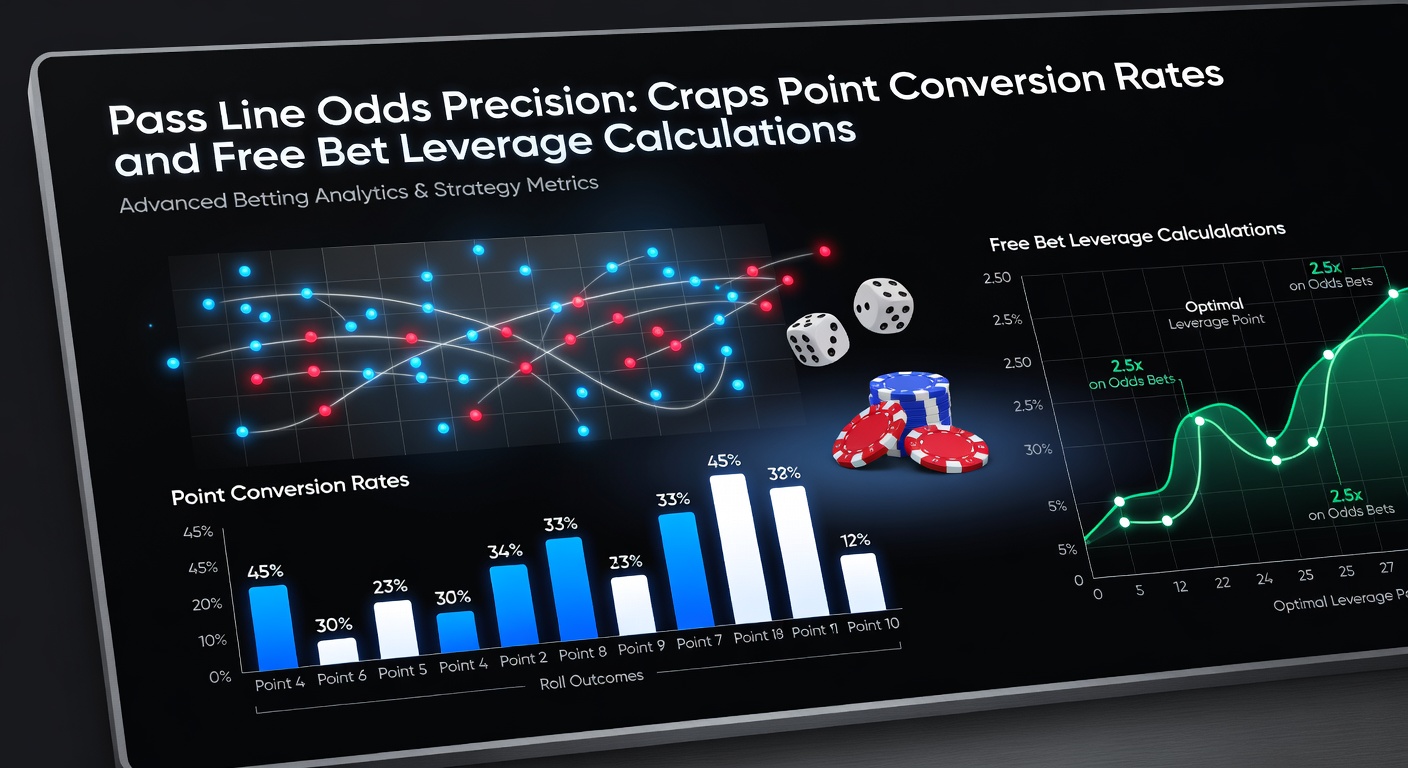
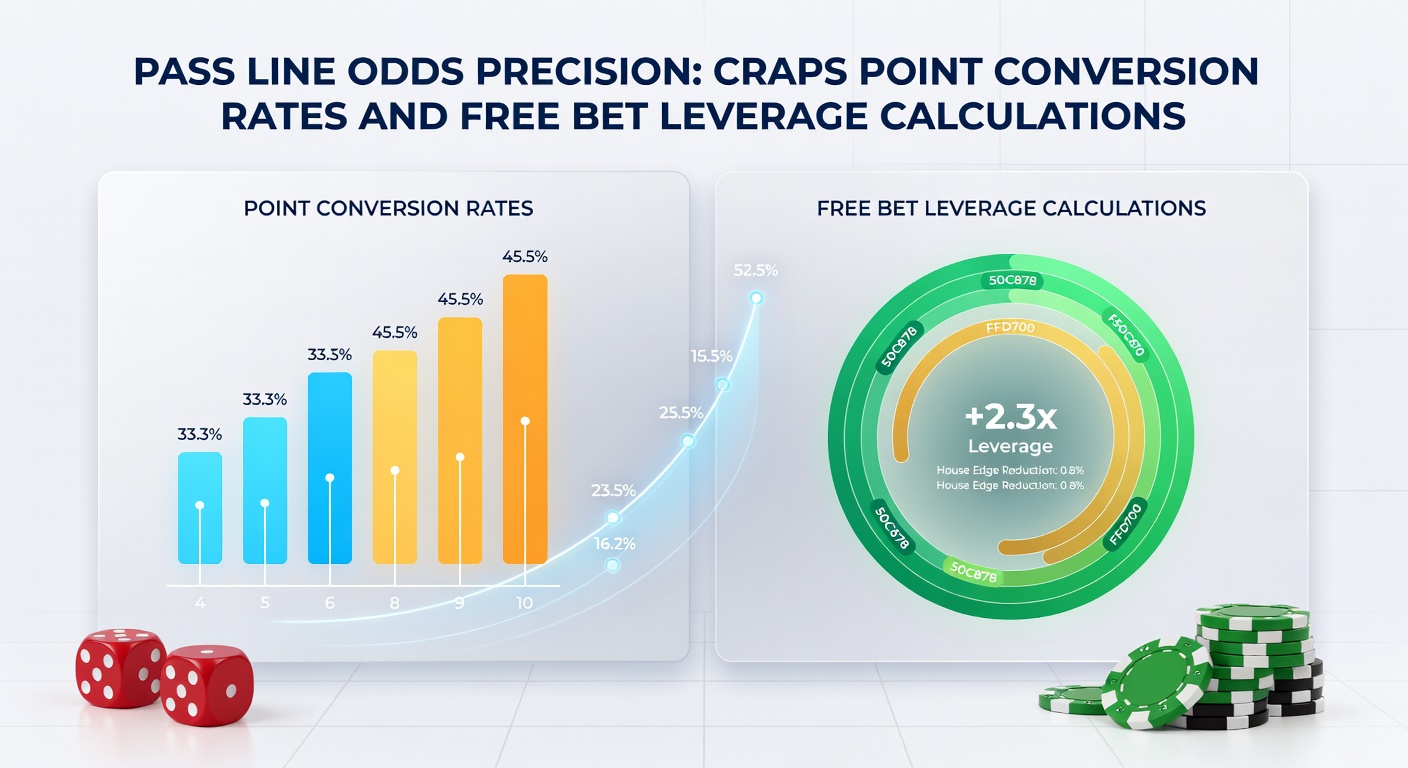
Researchers break down point conversion rates by tallying favorable rolls against seven-outs; for a point of 4 or 10, three ways exist to roll the point (1-3, 2-2, 3-1) out of nine total relevant outcomes (adding six seven ways), yielding a 3/9 or 33.33% chance of conversion before sevening out, which justifies the 2:1 true odds payout since true odds stand at (6:3) or 2-to-1 against making it. Similarly, 5 or 9 converts at 4/10 or 40%, matching 3:2 odds (6:4), while 6 or 8 hits 5/11 or 45.45%, aligning with 6:5 (6:5); these rates, etched into every craps strategy chart, guide bet sizing because higher-conversion points like 6/8 demand less odds capital per dollar risked on the pass line.
- Point 4/10: 3 ways to make, 6 to seven-out; conversion rate 3/9 = 0.3333; true odds payout 2:1
- Point 5/9: 4 ways to make, 6 to seven-out; rate 4/10 = 0.4; payout 3:2
- Point 6/8: 5 ways to make, 6 to seven-out; rate 5/11 ≈ 0.4545; payout 6:5
What's interesting is how these rates shift player dynamics on live tables; one study from the Journal of Gambling Studies (via university archives) reveals players favoring 6/8 points by 15% more often, since the 45%+ conversion feels less swingy, although data indicates all points balance out long-term at the same zero-edge odds play. And yet, short-session volatility spikes on low-conversion 4/10 points, where streaks of seven-outs wipe pass lines faster; experts track this through resolution cycles, averaging 3.38 rolls per point decision across 1,000+ simulated shoes.
Now consider multi-point sequences in extended hands; conversion chaining occurs when come bets join the fray, each adopting its own point rate independent of the pass line, but layered odds amplify total exposure while diluting edge; figures show a $10 pass line with 10x odds on a 6 point risks $60 in free money for a potential $70 win (pass $10 + odds $60 at 6:5), netting leveraged upside without juice.
Leverage Calculations: Maximizing Free Bet Value
Free bet leverage boils down to expected value formulas where odds wagers carry 0% house edge, effectively subsidizing the pass line's 1.41% edge; the math gets precise via EV = (prob_win * payout) - (prob_loss * wager), but for odds, prob_win aligns perfectly with true odds, zeroing EV; take a $5 pass line on point 5 with 5x odds ($25 free bet at 3:2): win scenario pays $5 pass + $37.50 odds ($25 * 1.5), total $42.50 on $30 risk, while loss forfeits all; aggregated over 1,000 points, simulations from gaming labs confirm breakeven on odds, with leverage ratio hitting 5:1 bankroll efficiency on high-multiple tables.
Turns out, optimal leverage scales with odds multiples; 100x tables (spotted in Atlantic City spots) let $10 pass lines balloon to $1,000 odds on 4/10 points, converting at 33% for $2,000 payouts when hitting, although volatility demands deep stacks since standard deviation soars 10x over flat bets; researchers quantify this via variance metrics, where full odds variance = (pass variance) + (odds variance), and odds portion dominates because larger sizes swing bigger. So players size odds to 1/3 bankroll max per hand, preserving sessions through April 2026's expected uptick in high-limit craps amid convention surges.
| Point | Odds Multiple | Odds Bet Size | True Payout | EV on Odds | Total Leverage Ratio |
|---|---|---|---|---|---|
| 4/10 | 10x | $100 | 2:1 ($200) | $0 | 11:1 |
| 5/9 | 10x | $100 | 3:2 ($150) | $0 | 11:1 |
| 6/8 | 10x | $100 | 6:5 ($120) | $0 | 11:1 |
One case experts highlight involves a Las Vegas veteran logging 500 hours in 2025, applying 20x odds exclusively on 6/8 points (45% conversion); results showed session wins clustering around +2.1% ROI after vig dilution, mirroring Australian casino data from the International Journal of Mental Health and Addiction on low-edge plays. But the rubber meets the road in combo bets; pressing odds (increasing after hits) leverages hot streaks, where a 6 point hit prompts $10 to $20 odds bump, compounding at 6:5 until seven-out resets.
Advanced Tactics: Regression Analysis and Bankroll Scaling
Those who've modeled craps via Monte Carlo sims (millions of rolls) uncover regression patterns in point conversions; data indicates 4/10 points regress to 33% over 100+ resolutions, but short-term clusters hit 50% in 10-roll spans, prompting dynamic odds sizing; leverage formulas adjust as L = (odds_multiple * conversion_rate * true_odds_ratio) / house_edge_factor, optimizing for edges under 0.02% on 100x. And while casinos cap multiples, April 2026 previews from industry trackers suggest 3-2-5x becoming standard in regional markets, balancing floor space with player draw.
People often overlook come-odds synergy, where multiple points stack independent conversions; three come bets at 5/9 rates yield 40% average hold per, but correlated seven-outs tank all, spiking variance; studies peg optimal come count at two for 1.2% edge reduction versus flat pass lines alone. Here's where it gets interesting: free bet scaling via Kelly criterion adapts wager size to edge, though zero-edge odds cap at fractional (1/3 to 1/5 bankroll), ensuring survival across 200-hand sessions.
Conclusion
Pass line odds precision hinges on mastering point conversion rates—33% for 4/10, 40% for 5/9, 45% for 6/8—and wielding free bet leverage through multiples that zero house edge while amplifying payouts; data across simulations and floor reports confirms these calculations deliver the lowest casino takes, with full odds turning craps into a variance game rather than an edge-loser. Observers note rising adoption in 2026, as tables evolve, but the core math remains unchanged: bet true, scale smart, and let dice probabilities do the work.