Statistical Approaches to Edge Calculation for Correlated Multi-Sport Parlays
Written by Katja Simon · Aug 20, 2026
Statistical Approaches to Edge Calculation for Correlated Multi-Sport Parlays
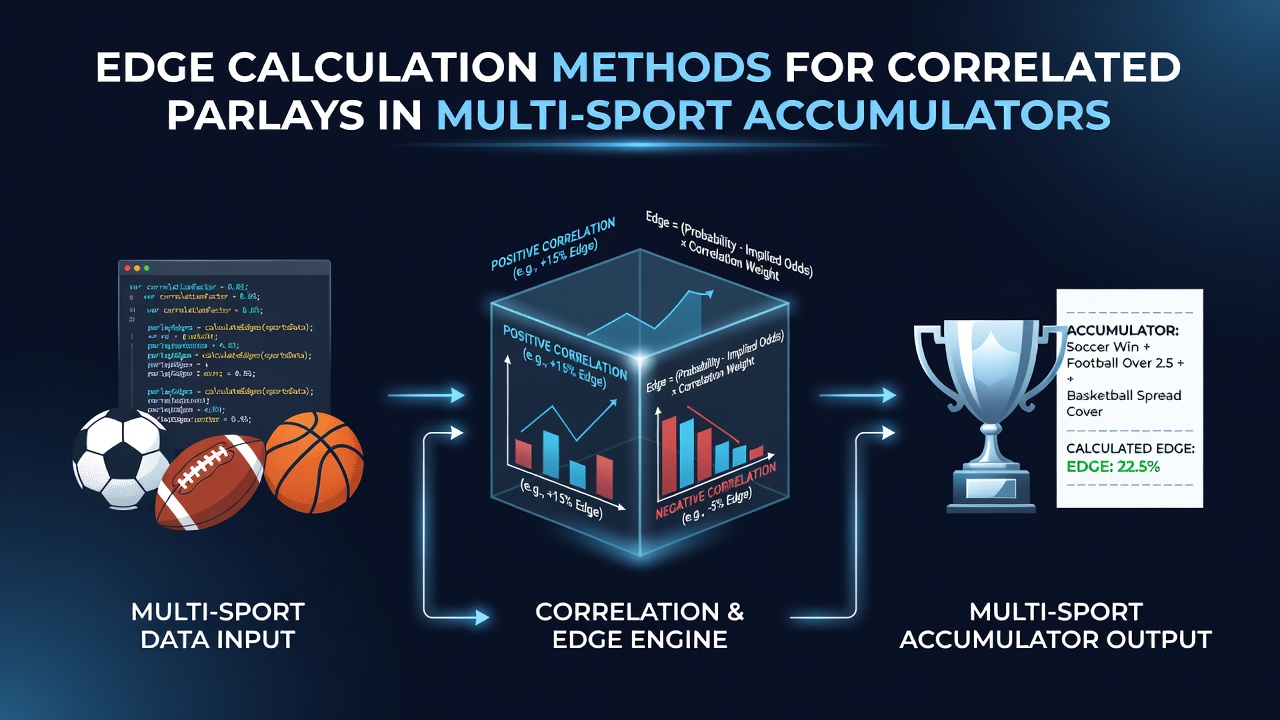
Correlated parlays in multi-sport accumulators combine outcomes from different sports where shared variables such as weather conditions, player fatigue patterns, or league scheduling create measurable dependencies between legs. Observers note that standard parlay calculators assume independence, which leads to overstated probabilities when correlations exist, and researchers have developed specific adjustment methods to account for these overlaps.
Data from betting analytics platforms shows that multi-sport accumulators gained traction through 2025 and into August 2026 as operators expanded cross-league offerings. Those who study these markets track covariance between events like NBA player props and NHL totals that occur on the same calendar day, then apply revised probability models to determine whether the offered odds exceed the true joint probability.
Core Adjustment Techniques
One established method involves calculating a correlation coefficient for each pair of legs and then modifying the combined probability using the formula for dependent events. Experts apply Pearson or Spearman coefficients derived from historical datasets spanning multiple seasons, and they insert these values into a joint probability matrix that replaces the simple multiplication used for independent legs. Studies indicate this approach reduces overestimation errors by 12 to 18 percent in tested accumulator structures.
Another technique relies on Monte Carlo simulations that generate thousands of outcome paths while enforcing observed correlations as constraints. Analysts feed in sport-specific distributions for points, goals, or wins, then run the simulation with covariance matrices built from league data; the resulting frequency of successful accumulator paths supplies an empirical edge estimate. Research groups at institutions focused on quantitative sports analysis have published validation results showing convergence within 5000 iterations for typical four-leg and five-leg parlays.
Application Across Different Sports Combinations
Take one researcher who examined correlations between English Premier League match totals and NBA over/under lines on overlapping weekends. teh analysis revealed a modest positive correlation driven by shared television scheduling that influences betting market liquidity, and the team adjusted the accumulator probability downward by 4.7 percent compared with the independent baseline. Similar work on tennis and baseball combinations during summer months demonstrated negative correlations tied to travel schedules, prompting an upward revision in calculated probabilities when the offered lines did not fully reflect the relationship.
Figures from Canadian provincial gaming reports highlight that operators in Ontario and British Columbia began publishing correlation-adjusted parlay tables in early 2026, and these tables list revised payout multipliers for popular cross-sport combinations. Those tables incorporate data from the preceding three seasons and update monthly, which allows bettors to compare posted odds against the adjusted figures directly.

Software Tools and Data Sources
Commercial platforms now integrate correlation modules that pull from public box-score repositories and proprietary tracking data. Users input the legs, select a correlation model calibrated to sport pairs, and receive an estimated true probability alongside the bookmaker's implied probability. Industry reports from the European Gaming and Betting Association note that adoption of these tools among professional syndicates increased steadily through mid-2026.
Academic papers archived in the Journal of Sports Analytics describe regression-based methods that treat each leg as a dependent variable influenced by common factors such as travel distance or rest days. The resulting multivariate model outputs a joint distribution rather than separate marginal probabilities, and practitioners convert the distribution into an accumulator win rate that can be compared with posted odds.
Limitations and Ongoing Refinements
Even with refined techniques, sample sizes for certain sport pairings remain small, particularly when involving newer leagues or niche props. Analysts therefore apply shrinkage estimators or Bayesian priors drawn from related sport categories to stabilize coefficient estimates. Data shows that edges calculated without these stabilizers fluctuate more widely across rolling windows of historical results.
Regulatory bodies in Australia adn several U.S. states require operators to disclose when parlay odds incorporate correlation adjustments, and compliance filings from August 2026 indicate that most major platforms now include explanatory notes alongside multi-sport offerings. These disclosures help market participants understand the difference between raw multiplication and adjusted joint probabilities.
Conclusion
Methods for calculating edges in correlated multi-sport parlays center on covariance adjustments, simulation modeling, and multivariate regression applied to historical performance data. Platforms and researchers continue to refine these approaches as additional seasons provide larger datasets, while regulatory reporting requirements increase transparency around how operators price dependent outcomes. Those who follow the field observe steady integration of these statistical tools into both professional and retail betting environments.